Leo Strauss Between Weimar and America by Adi Armon
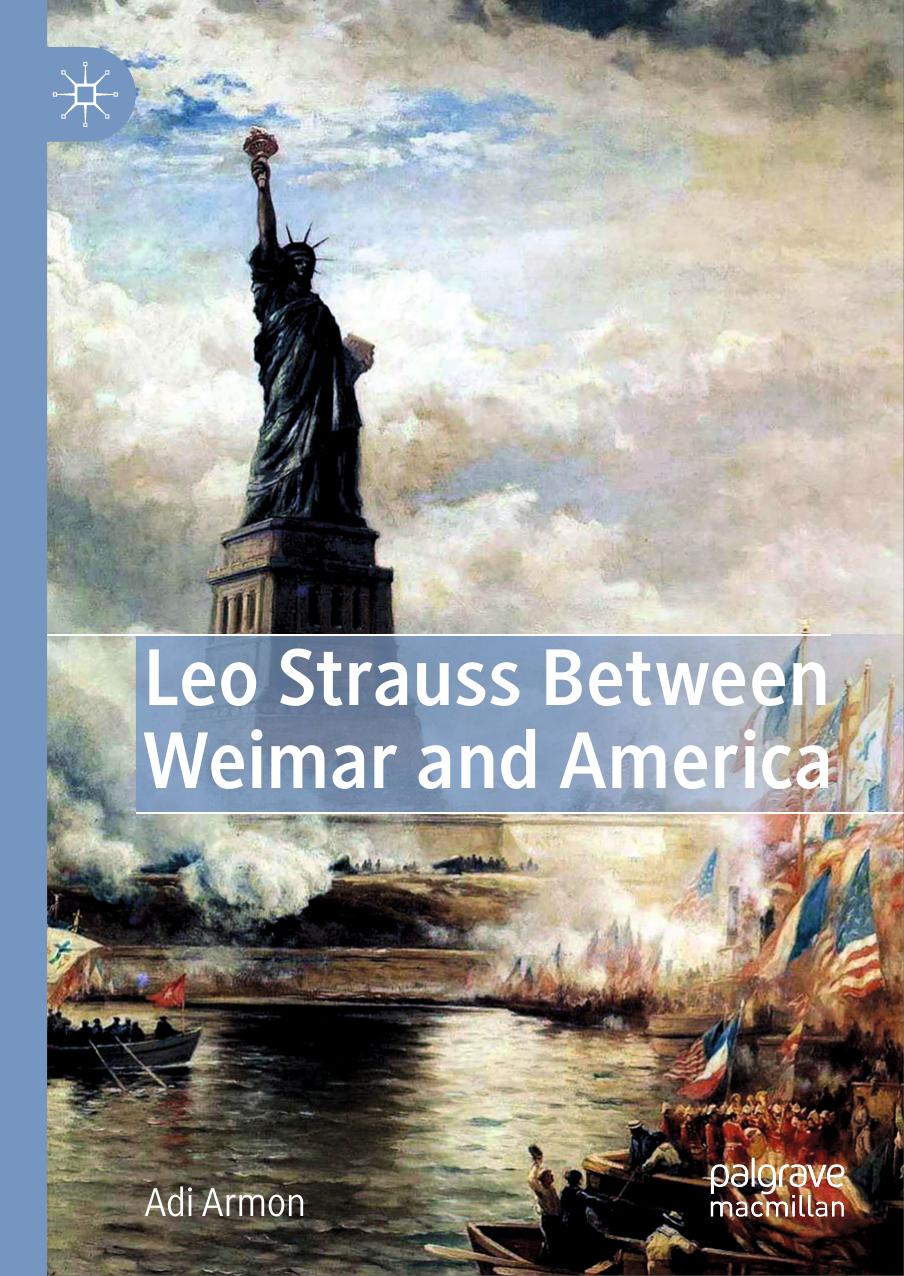
Author:Adi Armon
Language: eng
Format: epub, pdf
ISBN: 9783030243890
Publisher: Springer International Publishing
According to Strauss, this passage, which encapsulates the basic assumptions of American thought, validated the direct tie between unequal distribution of talent and happiness, or the conditions needed for happiness to exist: inequality in talent or skills enables some people to attain success and happiness and prevents others, less blessed, from fulfilling all their ambitions. 180 Despite the factionalism and clash of interests that arises from protecting unequal talent, it is vital to the republic that this variability be ensured. In contrast, Marx argued that unequal talent did not justify unequal pleasure or happiness. Instead, the focus was on peopleâs needs, and this should be the basis for constructing the proper political regime, which would bring about âthe end of history .â
Strauss saw modern philosophy as foreign to an immutable natural right, which was external to man and not bound by him. In contrast, according to Marx , modern alienated man was bewitched by all that he has created. God, the state, law, moneyâhumanity created all these, yet was now enslaved by them. Only when man could control creation could he overcome this state of alienation and end history, along with the problems of humanity. 181 A free society would be possible only once alienation was overcome.
Following Kojève , Strauss criticized Marxâs concept of freedom. The âlast man â at the end of history succeeded in escaping âthe realm of necessityâ and achieving âthe realm of freedom.â According to Kojève , the meaning of freedom at the end of history was the end of philosophy: humanity would not change and would no longer need to question the principles underlying its comprehension of the world. Regarding Capital, Kojève commented in a footnote on the Marxist distinction between âthe realm of necessity,â i.e. history, in which humanity fights for recognition and against nature, and âthe realm of freedom,â which is free of any conflict, both between people and between man and nature:The disappearance of Man at the end of History , therefore, is not a cosmic catastrophe: the natural World remains what it has been from all eternity. And therefore, it is not a biological catastrophe either: [m]an remains alive as animal in harmony with Nature or given Being. What disappears is Man properly so-calledâthat is, Action negating the given, and Error, or in general, the Subject opposed to the Object. In point of fact, the end of human Time or Historyâthat is, the definitive annihilation of Man properly so-called or of the free and historical individualâmeans quite simply the cessation of Action in the full sense of the term. Practically, this means: the disappearance of wars and bloody revolutions. And also the disappearance of Philosophy; for since Man himself no longer changes essentially, there is no longer any reason to change the (true) principles which are at the basis of his understanding of the World and of himself. But all the rest can be preserved indefinitely; art, love, play, etc., etc.; in short, everything that makes Man happy. Let us recall that this Hegelian theme, among many others, was taken up by Marx.
Download
Leo Strauss Between Weimar and America by Adi Armon.pdf
This site does not store any files on its server. We only index and link to content provided by other sites. Please contact the content providers to delete copyright contents if any and email us, we'll remove relevant links or contents immediately.
| Anthropology | Archaeology |
| Philosophy | Politics & Government |
| Social Sciences | Sociology |
| Women's Studies |
Cecilia; Or, Memoirs of an Heiress — Volume 1 by Fanny Burney(32558)
The Great Music City by Andrea Baker(32018)
Cecilia; Or, Memoirs of an Heiress — Volume 2 by Fanny Burney(31956)
Cecilia; Or, Memoirs of an Heiress — Volume 3 by Fanny Burney(31941)
We're Going to Need More Wine by Gabrielle Union(19046)
All the Missing Girls by Megan Miranda(16023)
Pimp by Iceberg Slim(14506)
For the Love of Europe by Rick Steves(14121)
Bombshells: Glamour Girls of a Lifetime by Sullivan Steve(14073)
Talking to Strangers by Malcolm Gladwell(13370)
Norse Mythology by Gaiman Neil(13363)
Fifty Shades Freed by E L James(13239)
Mindhunter: Inside the FBI's Elite Serial Crime Unit by John E. Douglas & Mark Olshaker(9339)
Crazy Rich Asians by Kevin Kwan(9290)
The Lost Art of Listening by Michael P. Nichols(7506)
Enlightenment Now: The Case for Reason, Science, Humanism, and Progress by Steven Pinker(7311)
The Four Agreements by Don Miguel Ruiz(6763)
Bad Blood by John Carreyrou(6621)
Weapons of Math Destruction by Cathy O'Neil(6279)
